WaveMaker’s journey, as it unfolded over the last 10 years

Founding and Early Years

Its been 10 years since WaveMaker was founded as a company. Like the rest of the founding team, I was part of the parent company, Pramati, that acquired the product from VMWare, and already had a reputation in platform technology – having won the global software industry race to the world's first J2EE certified App Server. By 2013, all of us in engineering had our share of experiences in building, selling and supporting world-class software platforms to global customers.

Also, a few years before Pramati’s original middleware server had morphed into an AWS infrastructure automation platform for another Pramati product called Qontext, a SaaS collaboration platform that was acquired by AutoDesk in 2012. Called CloudJEE, it was built to provide services for provisioning, configuration, observability and scaling to manage a large footprint of microservices for any SaaS Product.

After the Qontext exit, Pramati co-founder Vijay Pullur saw an opportunity to evaluate WaveMaker, then an open source Spring-based development platform being divested from VMWare, as part of their split of enterprise-software portfolio into Pivotal back in 2013.

Pramati acquired WaveMaker to combine CloudJEE capabilities with the development platform from WaveMaker, which had a community of 5,000+ developers world-wide. Platform-as-a-service (PaaS) was the buzzword then and a lot of enterprise software product companies were working on this idea, such as CloudFoundry, IBM BlueMix and RackSpace. WaveMaker developers were deploying to CloudFoundry. CloudJEE’s merger with WaveMaker gave us an edge to dive into this space and we transitioned them seamlessly to CloudJEE post acquisition.

Pramati founder Jay Pullur’s keen interest in UI/UX development and his desire to simplify UI development by providing Photoshop-like WYSIWYG tools for UI developers, set us on a path to re-build WaveMaker Studio.

When we got the product and its code, it was already aging fast in the light of new developments in JavaScript frameworks and HTML5, and Web in general. Recasting a product stack is always messy and full of surprises – especially when it has been acquired. But bravely, we began by ripping off the Dojo JS library and re-writing the studio in Angular JS. Sharad Singh Solanki – who had joined us a decade back as a furniture-designer turned UX-designer turned web-developer – headed this initiative building the initial UI team of JavaScript experts for WaveMaker.

Thus began a new road with challenges ahead to roll out this new recast studio, promising a radically new and accelerated development workspace entirely on cloud for a large community of developers. This was before anything called low code.

Growth and Milestones

The idea was to enable developers to sign-up or log into a SaaS development environment, without the hassles of downloading and setting up software on their Desktops or laptops. But the problem ahead was to provision a developer workspace within seconds, but at that time to launch a cloud or AWS instance it would take a few minutes even for the tiny or micro instance.

My engineering honcho and journeyman, Venugopal Jidagam, and I always had an inclination to explore new architecture and geek out on infrastructure. Light weight containers (LXC) were the thing of the day then. Docker was just kicking off. After evaluating Apache Mesos, Venu chose Docker to create a container orchestration platform. Soon enough, we were provisioning developer workspaces using containers in seconds, the first and fastest of its kind. Of course, being traditionally shy, we did not tom-tom this.

And then in September 2014, we launched WaveMakerOnline (WMO) bringing to your browser a full-feature WYSIWYG, open standards, modern app development cloud studio.

The Low Code Moniker

So, how did we end up being a low code platform? The category “low code” was created by John Rymer, a Forrester Analyst some time around 2014, to bucket a wide range of products that offered application building tools to non-specialist developers, so called “citizen developers”, with moderate software engineering skills. In 2015, we started to see several app development platforms re-position as low code platforms to gain analyst and enterprise attention. By early 2016, WaveMaker was surveyed and mentioned in the low code vendor landscape report for the first time by John Rymer.  Since then, WaveMaker has been associated with low code application development, offering developers significant productivity gains for end-to-end custom application delivery.

WaveMaker’s initial trajectory is a culmination of ideas from the founding members and we were all focused on building a modern development platform, to simplify enterprise app development. Chandrashekar, then heading creative and marketing functions, guided the design and branding efforts to set WaveMaker apart from the rest, giving it a unique brand identity as a design-led development platform, targeting developers who were happy to code complex applications but without the grunt work that comes with it.

Leadership and Culture

WaveMaker inherited its work culture from the group company Pramati, where each individual has a lot more ownership and cognitive responsibility in how they contribute to the growth of the product. While the overall strategic direction for the product is given by market and business imperatives, engineering strikes the right balance between embracing newer approaches and product stability. Product leaders and key developers are constantly scanning the technology landscape for new advancements and business impacts.

Attention to detail, engineering excellence in terms of performance, quality of software and focus on design are highly regarded and they become the yardstick for measuring success. Our steadfast adherence to these simple principles for more than a decade clearly reflects in the teams that we have assembled and the way they have shaped the product’s success.

While there are no shortcuts to building a world-class product, experimentation is key to innovation, even if they are orthogonal to the business direction. Eventually, when they converge, the impact on customer value is significant. Prashant Reddy, who was part of Qontext and joined AutoDesk as part of the acquisition, returned in 2018 to lead UI engineering efforts. He brought the right ingredients to create a culture of product innovation in WaveMaker.

Industry and Market

WaveMaker’s journey started at the beginning of an era with emerging Cloud adoption, fueling the proliferation of SaaS platforms, mobile apps and social collaboration. We have witnessed the phasing out of the PaaS and BPM markets with the resurgence of low code. Also saw the beginning of container deployments using Kubernetes.
At WaveMaker, we doubled down on enabling developers and software development teams in large organizations to embrace accelerated development, combined with a fully open-source strategy. As against the norm with low code platforms generally appealing to business users and leaning towards building internal departmental apps or business productivity apps, we tackled a harder challenge of enabling customer facing, experience app building with pixel-perfect UI needs.

WaveMaker’s unique approach of code-behind for Low-code app development set us apart from the competition, appealing to the development teams. The choice of technology stack and how the app code is generated, played a significant role for developer adoption. So, this also brought in a tedious task for us as a platform to keep up with the technology stack updates and make sure we beat the software upgrade cycles, so that our platform developers don’t need to go through this pain.

Achievements and Learnings

After the launch of WMO, we started to see mostly small businesses, startups and individual developers signing up to the platform, but the capabilities that we have built into the product are supposed to solve development challenges at large organizations. We rolled out WME (Enterprise Edition) in 2016 as we started to engage with in-house development or IT teams from large enterprises with a developer-based licensing model.

Some of these teams have skills shortage, but they have the steep hill task of building partner facing or customer facing apps, with stringent security and compliance requirements depending on the industry they are operating in. We have successfully onboarded some of these early customers on our Enterprise Edition and we were really excited to see these developers embracing the platform.

However, adoption of WaveMaker from a larger team of developers in an organization was still not on the cards, but we know for sure we’ll hit that mark very soon. Then in 2018, we signed a deal with a large financial services company in the US, in the analytics and credit scoring space. WaveMaker is adopted by their large professional services team to build and deliver fully custom apps integrated with their products.

While most organizations presume low-code platforms to enable citizen developers or those who don’t have technical expertise, some platforms started to position themselves as low code for professional developers. Analysts started to create a separate segment to accommodate low code for developers, while these platforms actually didn’t offer capabilities that appealed to software development teams. This posed difficulty to position ourselves in the market and to maximize the unique advantage we have as a development accelerator that really appealed to developers.

Vision for the Future

The big realization, we are not a low code platform! We are an accelerated development platform or AppGen platform for the future. Thanks to Gen AI and LLM’s ability to understand programming languages, frameworks and spit out real code. LLMs have been trained on open source frameworks and projects, that means we now have a huge advantage to leverage LLM’s ability as a code generator to amplify our acceleration strategy. WaveMaker had been a code generation platform all through emitting Angular and React Native code for building web and mobile apps.

While LLMs can be a co-pilot for assisting development, the code has to be brought in at developer’s discretion and developers need to really author the code for any real use. That may not sound much like acceleration nor skill reduction, but a platform strategy combined with approaches like design to code or prompt to code could really bring true acceleration.

UI development is very complex and UX plays a significant role in the growth and relevance of organisations. At WaveMaker we've seen the evolution of UI development trends, simplified web and mobile app delivery with component based reuse, providing a scalable development methodology for building and rolling out apps. By embracing Design Systems and combining AI-led approaches like design to code and UI co-pilot, we are embarking into the future of app development.

On a Personal Note

I'm very humbled with the journey so far and had an opportunity to really challenge my thinking and ability to bring novel approaches into our products. As a team we’ve always been at the early adoption curve for technology, that really puts us ahead of the rest. Also, the multitude of customer opportunities with a wide variety of application use cases over the last decade really challenged our ability to scale and adapt as a world-class product.

I'm grateful to the amazing team who have been through this journey with me and their perseverance in keeping spirits high through the thick and thin of product adoption and growth. What's remarkable is our team’s ability to spot talent and create developers with a deep understanding of technology and a purpose to solve problems and differentiate.
WaveMaker 11 GA is here!

A freshly minted React Native studio, developer tools, API composer toolkit, Angular 12 update, Azure Repos VCS, MLTS for REST APIs, and the list goes on………

WaveMaker is a composable experience development platform powered by the paradigm of low-code. With every new release, we at WaveMaker, attempt to carve out features that help enterprises and professional developers build captivating user experiences in sync with market demand.

Enterprises can embrace composability only when the tools that they adopt enable it. Keeping that in mind, our team at WaveMaker has built the next big thing for the world of composability through low-code—WaveMaker 11.

Here is what we have got for you this year!


Create truly native apps with React Native

With around 3.8 billion smartphone users worldwide, mobile app builders are constantly looking at ways to drive better engagement, reduce drop-offs and increase in-app growth. In short, mobile app adoption is driven by the user experience that they offer. 

On the other hand, ISVs and enterprises find it difficult to create consumer-grade mobile applications with run-of-the-mill tools that are either specific to a device or OS or, simply do not have an integrated platform to create both web and mobile apps. Moreover, customers are not content with responsive web experiences force-fitted within mobile apps. The UI and the associated user experience on web apps are just not good enough.

Building compelling user experiences such as smoother onboarding, faster startup, slick transitions, customer-centric features, native feature accessibility, and contextual awareness becomes easier with an app development platform that is tailor-made to create cross-platform native apps. 


WaveMaker 11 GA is here!

These are the factors that our team at WaveMaker kept in mind while crafting the WaveMaker React Native studio. In fact, there is an entire WaveMaker UI component library in the React Native studio that lets customers design and build mobile applications leveraging the low-code productivity that WaveMaker is famous for. Let us look at some of the salient features:

With React Native studio added to its kitty, WaveMaker is raising the bar in mobile app experience development one notch higher. Additionally, all web applications created in WaveMaker can be also made available as Progressive Web Applications, offering a plethora of choices for our customers.

We truly believe that if you are already a WaveMaker subscriber or considering the platform for your mobile app development efforts, the addition of React Native studio to the platform increases the value of your investment substantially.

To know more about the WaveMaker React Native studio, click here.


Move to Angular 12

The application modernization services market size is estimated to grow to $24.8 billion by 2025. A large chunk of this modernization effort can simply be attributed to upgrading the tech stack or modernizing the UI. However, in many cases, the cost of upgradation and the configuration hassles that come with it outweigh the benefits of modernization and as a result, companies are forced to take a step back. 

At WaveMaker, we have always promised that upgrading to the latest version of WaveMaker also includes upgrading to the latest tech stack. This is by default.

WaveMaker 11 GA has upgraded to Angular 12 from Angular 11. This simply means that if you open any of your applications previously built on older versions of WaveMaker in WaveMaker 11, they automatically get upgraded to Angular 12. The ROI in terms of cost and time, in this case, is substantially higher when compared to a manual upgrade.


Orchestrate APIs with API Composer Toolkit

Customers need seamless and smooth user experiences. Building such performant applications needs an API backend that is fast. The new release aims to bring composability to the API layer, allowing multiple APIs to be combined together to create unified experience APIs. 

The API Composer Toolkit allows WaveMaker developers to build APIs on top of existing systems that are just right in terms of verbosity and comply with the “Principle of Least Privilege” security rules. Using the Spring framework, this tool allows the creation of unified experience APIs that are designed keeping in mind the  ‘backend for the frontend’ design pattern. With API Composer Toolkit, developers can now leverage the use of a single Java Service API that calls multiple APIs(REST/Swagger/Database) and consolidates their responses into one Response Object thereby reducing time and code complexity.

To know more about the API Composer Toolkit, click here.


Get support for Azure Repos VCS

WaveMaker Studio already comes with a version control system that runs within your platform machine. This is based on Gitlab. Additionally, WaveMaker Teams customers can choose to add an external repo of their choice like their own instance of GitLab, GitHub, or BitBucket. With WaveMaker 11, team admins can configure Azure Repos Version Control System (VCS) for storing project source code. You can now easily set up CI/CD pipelines to build and deploy WaveMaker-built applications on top of your enterprise version control system. Not only is there a reduction in the total cost of ownership of WaveMaker, but it also enables Teams customers to use existing IT infrastructure.

 For more information, see Azure Repos Code Repository.


MTLS for REST APIs in WaveMaker Apps

WaveMaker has always stayed true to its promise of building applications that are safe, secure, and easy to run. Enabling an additional security layer by configuring MTLS (Mutual Transport Layer Security) for all REST APIs is a feature directed toward building secure apps. With this feature, when you import APIs into WaveMaker to build your apps, you can now set up the SSL connection between WaveMaker and your APIs to use MTLS.

For more information, see MTLS in the WaveMaker application and a detailed blog about MTLS.


Supporting MongoDB for Session Persistence

WaveMaker applications are built to 12Factors.app principles. One of the ways WaveMaker apps can be deployed on horizontally scaled infrastructure is to build them to be stateless. With WaveMaker 11, application sessions can now be configured to use a distributed cache. We already support DB, and REDIS and have now added MongoDB to offer more flexibility during the deployment.


Debug and monitor with Devtool - a WaveMaker Chrome Extension

Debugging and monitoring your applications can be a daunting task. Make debugging your application easier with WaveMaker Devtool. Installing this chrome extension will let you debug and monitor WaveMaker 11 applications in preview via the ‘inspect’ mode. To further enhance developer productivity, this browser plugin enables developers to track and profile API invocations, page load times, prefab load/render times, etc.


Leverage the change in the POM hierarchy

Take advantage of a simple yet powerful pom.xml and create a clear separation of the WaveMaker platform from application-specific dependencies. The new POM contains fewer lines than before and has been remodeled to inherit from the parent POM making it easily readable and comprehensible.


Upgrade to the new version of SAML

All WaveMaker projects that are using SAML(spring-security-saml2-core) as a security provider will be migrated to a new version of SAML thus removing the dependency on Spring extensions that have reached the end of life.


Collaborate with ‘Teams’ on WaveMaker Enterprise

Teams, a collaborative development environment is now shipped with WaveMaker Enterprise too. Within one enterprise installation, you can onboard multiple Teams, while giving each Team ability to manage projects, roles, and code repositories, add or remove team members, grant permissions, and more. Read this blog to know more about what Teams can do for you.


Summary

Our freshly minted React Native studio brings low-code and React Native mobile frameworks together, allowing mobile app composition using prefabs. For a WaveMaker developer, there is no new learning curve; for a mobile developer, there is the flexibility of low-code, the feature-rich app development framework, and the support for easy composability.

This new release is a milestone for WaveMaker. This release, while offering composability at the API layer, allows unified experience development. Additionally, the API Mock Server increases developer productivity with mock APIs that can be created during development. This enables UI development teams to continue building the experiences using low code without the need for a fully developed/functional API. 

WaveMaker 11 GA brings with it a host of other features that increases the value proposition of being subscribed to WaveMaker. From Flex Layout Widgets, Java 11 upgrade, and pagination for imported APIs, to multi-version studios, WaveMaker 11 GA aims to increase the value proposition for WaveMaker subscribers and prospects alike. With this release, we can truly say that composability and seamless native mobile app development is just an upgrade away!


WaveMaker 11 GA - Build Components. Compose Journeys. Differentiate the Experience


To read the full list of features in WaveMaker 11, please read the release notes here.


Create powerful apps using model-driven development and RAD tools

Make data more digestible

A byte about visual modeling and programming

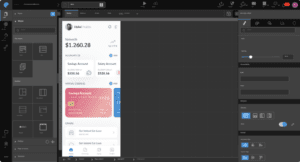
Visual modeling and visual programming techniques transform numbers into visual elements such as charts, maps, graphs, and tables using standard graphical notations. Data visualization is crucial in supporting real-time decision making and has become a core feature in modern application development platforms. Visual modeling and programming not only allow you to build a model of your system or application, but also to model systems easier, faster and more accurately on the front-end, while maintaining the syntaxes and semantics at the back-end.

Try Model-Driven Development

Today’s software and application demands require a ready-to-use foundation before anything is built on it. To eliminate iterations in your application development lifecycle, a powerful approach is to adopt model-driven development. By using a model as a starting point to describe your business semantics and then generating application artifacts from that model, you can deliver applications faster with higher productivity.

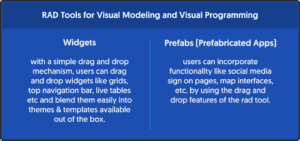
What low-code platforms have brought to the table in terms of visual modeling and programming, is easy-to-use, drag and drop features, and customizable widgets, helping you to create critical and device-agnostic applications with responsive dashboards.

Whether it is full or partial dependency, find out what type of Model-Driven App Development Approach suits your business and application development needs.

Achieve data visualization with minimal coding

Take Visual Modeling and Programming to Next Level Using Low-Code

“It took a single developer 1 week to build an entire application!” Find out how low-code addressed a real-world problem using visual modelling techniques.

The Low-Code Leverage

Advantages of using WaveMaker for visual modeling and programming

Visual programming and visual modeling just got easier. You can instantly create a chart, plot a map, or build a dashboard to visualize data from any source using WaveMaker. By using built-in widgets and prefabs, you can build applications within days without any need for coding.

  • Ensure high quality of code : Incorporating the best practices followed by professional Java or Javascript developers, WaveMaker guarantees best code quality, maintainability and extensibility for enterprise application use.
  • Automate code generation :  Taking a radically different approach to use open-standards based generated code, the WaveMaker platform automatically generates code for every action performed via drag & drop features.
  • Lower costs :  Experience significant reduction in development and maintenance costs. Enterprises using the WaveMaker platform for application development have, in some cases, lowered maintenance costs up to 75%.
  • Reduce coding effort with fewer resources : Applications can be developed rapidly on WaveMaker with easy prototyping, testing and deployment, with 80% less coding effort and fewer resources.
  • Intuitive and visual : Built not only keeping in mind developers, but also business users, the WaveMaker platform offers unique drag & drop features, WYSIWYG layouts and out of the box themes and template designs, making application development easy for any user.
  • Save time on application development : Enterprise users experience, on an average, 67% faster application development time using the WaveMaker platform, when compared to traditional software delivery.

It’s a data-driven world! Whether the objective is to visualize data, modernize legacy systems, or deliver a personalized experience, business-critical applications are being developed at greater speed. To develop customized applications at greater speed, low-code provides professional developers with the much-needed agility.

Find out how you can enhance your visual programming and visual modeling techniques using low-code.

Explore WaveMaker’s RAD Platform

Is your low-code outdated?

Low-code means different things to different people. While the industry is exploding with low-code platforms, ours is purpose-built for professional developers. If you are already using a low-code platform or shopping for one, there are many critical factors to consider. Read on..

Start with these simple questions first

Will I be the owner of the code?
The code should be yours to mix, extend, customize, transfer or export
What should “no lock-in” mean to me?
No shackles of run-time cost, proprietary architecture, and limited infra options

Will the developers need to be certified to use the platform?
You want quick learning and future-proofing your teams’ skills

Is my vendor’s pricing strategy sustainable?
Scaling up shouldn’t disproportionately increase the cost of doing business


Low-code vs Low-code

With over 2 decades of experience in the application development and modernization field, our product evangelists have enlisted 12 critical capabilities to consider while comparing various low-code platforms.
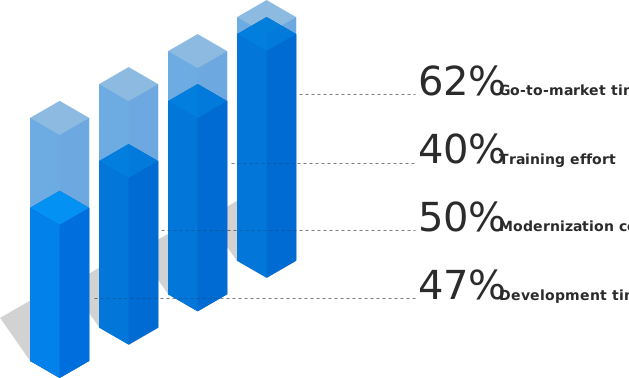
Find out how the 5 most popular low-code platforms stack up on each of these capabilities. Download the document for an objective, quick, and consumable take on the comparison of low-code platforms


CODERS love low code when

CXOS like low code when

WaveMaker saves

Reduce repetitive development work and save heaps in time and effort.

Enterprise Application Development Software

Explore the unique requirements of enterprise application development and learn how to choose the right enterprise application development software.

Enterprise Application Development is a complex process of creating application for business purposes. They are complex, customized for critical business requirements and can be deployed on the cloud, on a variety of platforms across corporate networks, intranet etc. Designing and developing such enterprise applications means satisfying hundreds or thousands of separate requirements.

How are Enterprise Applications Different ?

An enterprise applications are large multi user, multi developer and a multi component applications that can work on large chunks of data and utilise extensive parallel processing, network distributed resources and complex logic. These applications can be deployed across multiple platforms and operate simultaneously with many other applications.Enterprise applications are business oriented and deployed to meet specific business requirements. They encode business policies, processes, rules and entities and are developed with specific business requirements in mind. Hence, these applications require special tools in the form of enterprise application development software to cater to their unique needs.

Traditional Enterprise Application Development Software and their Shortcomings

Though traditional application development methodologies, are known for having clear objectives, stable requirements and measurable progress of development, they are time consuming, have minimum iterations and there is very little customer interaction. Hence, traditional application development methodologies and tools are unable to fulfill the demands of modern enterprise applications.The failure is not just for web applications, traditional methodologies are not a perfect match for mobile application development as well. Some of their shortcomings are

Hence it can be summed up that Enterprises today are in the look out for better tools, applications and software as the traditional methodologies could not gain much success.

Changing Trends in Enterprise Application Development

New and Emerging trends in Enterprise Application is impacting application development in a big way. Let us see the key trends :

Usability (UX) – Usability is the norm of the day in when it comes to Enterprise Architecture. Users expect their apps to be more intuitive and provide more relevant content suited to their own business needs. In the coming year, developers will have to focus more on ease of usability and responsive design.

Consumerization of IT– Consumerization of IT has impacted Enterprise Application’s changing landscape. Technology today is consumer oriented. Business imperatives are given utmost importance.

Commodity Computing (cloud), horizontal scaling – Applications today are hosted , developed and customised on the cloud . Cloud computing has increased accessibility and ease of operation for users of Enterprise application development.

Rapid Application Delivery & Low-code Development – RAD or Low-code development is the new trend in Enterprise. Minimal Coding is making Enterprise Application Development more business centric and easy. Customers are involved at each phase of development.

Loose Coupling (APIs, Microservices, Composable architecture) – With the introduction of Loose Coupling and microservices enterprise applications are delivered as an independent runtime service with a well defined API. The Microservices approach allow faster delivery of smaller incremental changes to an application.


Traditional methodologies of application development are very rigid and process oriented. They involve a series of steps like requirement, definition, planning, building, testing and deployment which lead to high cycle times at each stage. The traditional format requires projects with large teams and strict roles while maintaining stringent documentation and review at every stage of development. The customer interaction is minimal which takes place during the beginning and the end of the project. Every element that is designed in a project needs to be designed from scratch and is not reusable. All this translates to,


Choosing the right enterprise application development platforms

Modern enterprise Application development focusses on reducing application development timelines and at the same time addresses a whole gamut of other related aspects of modern web applications required for today’s modern Enterprise. Modern day application is rapid in terms of timeline, cost, and usability . We call them RAD ( Rapid Application Development) and they emphasizes on:

Ready-made Application Infrastructure: Providing a browser based development environment. No more hassle of installing, setup, ongoing configuration etc.

Usability: Making sure good-looking and rich user interactive applications can be developed. Increased attention to creating pixel perfect responsive UI applications on both Desktop as well as Mobile Devices.

Full Stack Development: By leveraging modern client side frameworks and server side technologies, Modern RAD is now capable to auto generate code for the entire application (client side, Server side as well as integration touch points to external systems and services via APIs).

Pre-Defined Best of Breed Technology Stack: Providing a pre-defined well tested best of breed of software components as the technology stack for application development. No more worries about enterprises having to maintain multiple teams to support complex permutations of technology stacks.

Business User Participation: Simplifying the application development process such that technical business users can work together with professional developers in developing the application. This greatly benefits enterprises as business user comes in with domain knowledge and can validate the implementation, as it is being developed.

API-led Integration: Providing REST API based integration approach such that application can easily integrate to an internal, external as well as Cloud based service. This allows for faster, easier development and avoids reinventing the wheel again.

WaveMaker – the ideal enterprise application development software

WaveMaker is an award winning rapidly Enterprise application development and delivery platform that helps create enterprise grade web and mobile apps. With over 10 years of market presence, thousands of developers use it to create applications 67% faster.
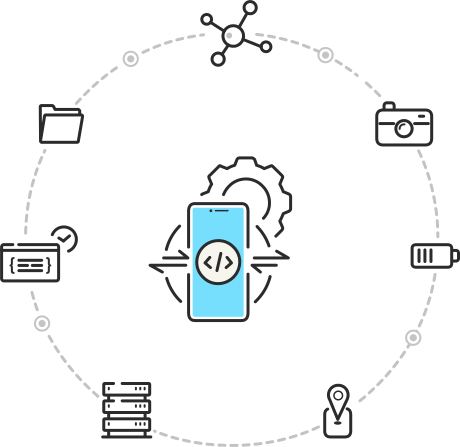
WaveMaker’s software platform revolutionizes how enterprises build, deliver and manage modern custom applications, improving business agility and fostering innovation. WaveMaker leverages the latest trends and technologies in Rapid App Development (RAD) such as multi-device auto-responsive interfaces and componentized app assembly, Docker for app-optimized container deployment on private infrastructures, and APIs and Microservices Architecture (MSA) for scalable integration.

Get Started with a free 30 day trial of WaveMaker Enterprise Web Application Platform.

Custom Application Development

A RAD approach to build future-ready apps​
One way to drive the adoption of applications is to build one that’s customized to the user. When you have teams within teams, from cross-functional to self-managing teams, every user, from an IT leader to a line of business (LoB) executive, demands modern applications designed to their requirements. The essence of agile enterprises is to create value and flexibility for business users with fluid IT capabilities.

IT cannot deliver all the custom apps that your business needs Address the pace of your application development needs with Custom Application Development Services

Create new or extend existing applications

Create native experiences

Drive application adoption and use

Build enterprise-grade, custom applications that are future-ready with wavemaker

RAD platforms such as WaveMaker are revolutionizing how enterprises build, deliver, and manage modern custom applications. Improve business agility, foster innovation and accelerate application development.

Application Modernization with Low-Code

Accelerate the journey to cloud-native, omnichannel, microservices-based enterprise-grade applications with a composable experience platform powered by low-code.

A McKinsey survey found that in 2021, “companies devoted more resources to their digital and technology capabilities during the pandemic, even as they cut resources from other parts of the business.”

This should come as no surprise given the dramatic change in business models, competitive landscape, and customer behavior seen in the last couple of years. In response, enterprises across the globe are modernizing their application stack to increase agility and performance, and provide compelling customer experiences.


What is application modernization?

Application modernization is the process of identifying legacy apps—which are typically on-premise, monolithic, and written in outdated languages—and modernizing them into cloud-native, omnichannel, microservices-based, feature-rich digital applications rich with intuitive customer experiences.

It is important to note that application modernization is not just about upgrading the software. It is often also accompanied by a modernization of processes to be more agile with shorter release cycles and the transformation of the organization itself to be more experimental and innovative.


What does application modernization entail?

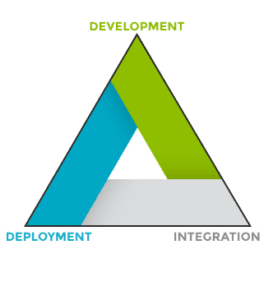
An application modernization initiative is driven by changes across the three levels of the app: Experience, integration, and architecture.


Experience modernization

Upgrading the user experience (UX) layer for a more modern, responsive, cross-platform design to deliver personalized experiences to customers.


API modernization and integration

Making legacy data accessible through channels like the cloud, mobile, web, etc. via APIs. A well-managed API serves as a mechanism for enterprises to leverage their digital assets and build new products around their core capabilities.


Architecture modernization

Transforming the architectural foundation of applications by adopting modern technologies to enable agility, scalability, portability, speed-to-market, development efficiency, and ongoing innovation.


Cloud-native architecture

Using hybrid architectures including public and private clouds allowing an enterprise to move workloads between the two platforms. Sensitive data can be hosted on a private cloud for security while big data applications can be stored on a public cloud for cost efficiency.


Microservices

Leveraging modular, distributed, small, single-purpose applications called microservices that deliver services using APIs. Microservices is poised to take scalability and continuous delivery to the next levels in the years to come.


Containerization

Building portability and reducing infra dependency with containers, which wrap up an application in a complete filesystem that has everything it needs to run: code, runtime, system tools, and system libraries. This enables it to run smoothly regardless of any environment.


DevOps

Transforming development methodologies from traditional waterfall towards DevOps and DevSecOps models, bringing agility, speed, and efficiency into enterprise teams. It empowers technology teams with experimentation and innovation capabilities, so they can adapt to market needs more effectively.


Why do enterprises need application modernization?

Traditionally, applications are built around operational efficiency—delivering the best possible service in the cheapest way they can. Today, this is not enough. Organizations need more. They need:


Differentiated and personalized experiences

In the rapidly changing world, customers demand their banking app or online shopping app to deliver the same sticky and personalized experience that their social media and gaming app offers. Legacy applications are unable to deliver this. To meet the customers where they are and deliver on their needs, enterprises need application modernization.


Faster time to market

Enterprises can not afford to build an internal team or outsource to an external vendor and wait for months to launch new features. For instance, when the pandemic hit and banks needed to sell online, they couldn’t wait a year to develop that capability. Today, taking digital experiences to the market quickly can be the most powerful competitive advantage. Legacy apps can’t enable that. IT modernization has the potential to reduce defects and time-to-market by up to 60%.


Optimizing costs

Legacy monolithic applications are large and take up significant resources to function. Application modernization breaks them down into smaller, manageable microservices, using only the resources that are absolutely necessary. Additionally, by leveraging composability, enterprises and software vendors can also create a repository of functional components that can be retrofit into existing applications, gradually replacing existing functionalities while not disturbing existing processes and thereby, reducing costs. With containers, modern libraries, and dynamic scaling of cloud platforms, organizations can save both real and opportunity costs of running enterprise applications.


Ongoing security

Every day, new threats are emerging online. Monitoring and protecting legacy applications can be a mammoth endeavor in itself. Application modernization enables enterprises to build more secure applications, shifting security left in the development process. Moreover, it also makes it easier to address security threats and deploy patches faster and more effectively.


Improved developer productivity

Legacy applications are often written in languages and follow processes that do not have the talent pool available to develop and maintain them. Containerization allows polyglot teams to function effectively together, setting up dev environments faster and ensuring that the app works on production environments the same way it did on the developer’s machine. With a composable approach, functional components created by IT teams can further be reused by business developers and implementation teams to quickly modernize smaller bits of applications. In fact, with IT modernization, enterprises increase employee productivity by up to 30% and motivation by up to 40%.


Organizational agility

More often than not, application modernization is not merely changing the software to a modern environment. It is accompanied by a cultural change towards building smaller services, deploying them in smaller cycles, receiving feedback, and optimizing continuously. To leverage cloud platforms, containers, DevOps processes, etc., the organization needs to transform itself into an agile and adaptive enterprise—a change that powers sustainable growth and profitability.


What are the key challenges in adopting application modernization?

While the benefits are overwhelming, enterprises continue to struggle to adopt application modernization for a range of reasons.


Dearth of talent

Application modernization initiatives often involve the transformation of mammoth applications. This not only requires technologists who understand cloud-native, microservices-based app development but also have a clear grasp of business logic and industry acumen. This combination of subject matter expertise and technology skills is a challenge to find.


Fear of disruption

IT leaders often fear disruption of their mission-critical enterprise applications, and rightly so. Moreover, the enterprise technology landscape can be so complex and precarious that touching one app can bring the entire deck of cards down. Therefore, creating the right application modernization strategy that ensures a smooth transition from legacy to modern applications remains a challenge.


Lack of budgets

Large-scale application modernization projects can be expensive, whether you’re building with an internal team or outsourcing it to an external vendor. Without a clear view of the return on investment, IT leaders struggle without the budgets to launch app modernization projects.


Large number of applications

A recent study found that enterprises use an average of 200 applications, with security, engineering, and IT using the most. While some of these are SaaS products, most tend to be legacy apps. Modernizing them all at once would be a significant burden on the company’s bottom line. Without repeatable architectures and composability, the redundancy of work will also be high.


IT and business not talking to each other

For any technology initiative to demonstrate value, it needs to meet the needs of the business. When IT and business teams don’t talk to each other, they run the risk of launching application modernization initiatives that don’t drive business results. This affects the organization’s—teams, leaders and the board included—enthusiasm towards application modernization.


Past failures

For decades, enterprises have attempted to modernize their applications with little success. A recent BCG study showed that “70% of digital transformations fall short of their objectives, often with profound consequences.” Once bitten, twice shy, IT leaders resist taking the plunge again.


What do enterprises need for application modernization success?

Not all application modernization initiatives are the same. To ensure success, enterprises need to adopt an app modernization strategy that works for them. Here are some pointers to keep in mind.


Taking a business-centric approach:

It is not uncommon for enterprises to choose the oldest application to modernize first. This app modernization strategy, even when the project is successful, falls short of the business transformation it can deliver. Instead, we recommend that enterprises choose applications that offer the most valuable business capabilities. When an app modernization initiative delivers ROI, it makes it easier for the entire organization to get behind it.


Choosing the right application to modernize:

Gartner suggests that enterprises evaluate potential apps to modernize on six drivers. Three of them are business-related: business fit, business value, and agility; and the other three are technology-related: cost, complexity, and risk. The best opportunities offer transformation across multiple drivers.


Building a business case:

Whether you’re beginning a pilot project, or modernizing your nth application, a clear, strong, relevant, outcome-driven business case shields you against the risks of failure in several ways.


Creating progressive change:

Instead of entirely dumping the enterprise application for a modernized one, organizations must consider a progressive approach to breaking down monolithic apps for microservices-based ones. By integrating legacy systems with modern apps through APIs, enterprises can continue their business as usual without disruption, while building future-proof tech along the way.


Having a holistic view of modernization:

We believe that for application modernization to deliver on its promises, it must impact at three levels: Infrastructure, development, and delivery. A strong app modernization strategy must enable multi-cloud leverage, rapid and error-free containerized delivery to create open standards, multi-channel and microservices-based apps.


A modernization accelerator:

Time-sensitive and cost-conscious projects can not wait for months to build. They need the speed that can only be delivered through automation, simplified integrations, dynamic scale, etc. They need to minimize redundancies and reuse existing builds. They need a robust low-code platform to accelerate enterprise application development.


Rapid app modernization with low-code


What is low-code?

Low-code is a modern approach to agile software development. A low-code development platform helps developers create products visually by abstracting and automating commonly used components. Developers can easily drag and drop commonly used features instead of having to code extensively.


How does low-code help in application modernization?

Addressing all of the above challenges intuitively, low-code is one of the best app modernization tools available today.

How does application modernization with low-code work?

A good low-code platform serves as an app modernization tool that abstracts and automates processes at every stage of the software development lifecycle. How to choose the right platform for rapid app modernization with low-code?

While choosing the low-code platform for your application modernization strategy, ask yourself the following questions.


1. Is the platform suitable for professional developers?

A good low-code platform can be the app modernization tool of choice for professional coders, who want to build powerful, long-lived applications that offer a differentiated experience on the web and mobile, which can evolve with user needs.


2. Is the platform built on open standards?

A good low-code platform needs to have the foundation of open standards in order to ensure an open and extensible approach to application delivery. Also, the platform should use a best-of-breed application stack for developing full-stack applications.


3. Does the platform simplify external integration with inbuilt integrations?

A good low-code platform must enable out-of-the-box integrations for data and services. It must offer custom integrations to be built and reused across apps. It must also enable integrations with legacy applications for implementing incremental development.

For instance, the information and digital systems office of the State of Geneva incrementally modernized over 40 applications using WaveMaker while keeping the integrations intact for seamless BAU.


4. Does it offer cross-platform development?

A good low-code platform must offer the ability to create applications using a single code base that can adapt to any native platform or operating system, be it iOS, Android, Windows Mobile, BlackBerry/RIM, etc.

Canadian foodservice distributor, Flanagan, leveraged WaveMaker to achieve this. They reached out to WaveMaker to replace the existing application with a modern and responsive interface that provided a better, more consistent user experience across browsers and devices.


5. Does it handle scalability and cloud needs?

An end-to-end low-code platform will offer the ability to scale applications and handle private cloud needs. This will be in the form of features for rapid and continuous provisioning, deployment, instant scale-ability, and maximum utilization of resources.


6. Does it make it easy to create, share and consume APIs?

A robust platform will take an API-first approach to application delivery, making it easy to import data from any service and bind it to UI components.


7. Is it easy to maintain code?

A sustainability-focused low-code platform ensures maintainability, where the code generated follows design patterns, is well-organized, uses standard naming conventions, and generates documentation that developers can understand and maintain.


8. How well does the platform handle security?

A secure low-code platform will support flexible authentication and authorization mechanisms as well as integration support for popular identity management systems like AD, LDAP, SSO, and OAuth.


9. How well does the platform handle customizations?

A flexible low-code platform will allow customizations in the form of leveraging their existing systems or the ability to allow custom coding or integrations with modern AI and IoT-based systems.


10. How can the platform accelerate the development of multiple apps?

A good low-code platform not only accelerates the development of your first app but also strengthens the foundations of ongoing modernization. For instance, with a composable experience platform, you can create custom user journeys such as completing a transaction or creating a dashboard. This user journey can then be used to build new apps — all it takes is to plug and play. At each new app, users can customize it, if needed.

This is what J.J Richards, a WaveMaker customer, did while building a comprehensive set of 10 critical applications using a lean team within just 18 months!


11. Is the platform future-proof?

A good low-code platform should have the latest tech stack that allows you to build a modern responsive UI in your apps. The platform should make it easy to move your workload, i.e your applications to multi-clouds with containerization. Furthermore, the platform should be flexible in integrating or adapting to newer technologies and trends entering the market.

Like the Bank of Social Security, the Netherlands did while transitioning their mission-critical applications from the Microsoft framework to Java low-code in mere months.


Begin your application modernization journey with WaveMaker’s composable experience platform powered by low-code

WaveMaker is the most open, extensible, and flexible Low-code Platform that complements your enterprise application delivery while keeping in mind the requirements of Software Developers, Citizen Developers/Business Users, IT Architects, and CIOs.


Bank of Social Security, Netherlands modernized legacy apps and built new ones with WaveMaker.
Read case study
The information and digital systems office of the State of Geneva built 40+ applications with complex integrations using WaveMaker.
Read case study
Australian waste management company achieves rapid modernization of 10 critical applications leveraging WaveMaker.
Read case study
Canada’s largest independent foodservice distributor improved user experience with WaveMaker.
Read case study

Start a 30-day, free trial today at www.wavemaker.com/get-started

Embedded Finance, Low-Code and the Emerging Face of Adaptability

The years 2020-21 will be remembered for the pandemic and the subsequent resurgence. It will also be remembered for the time where over half the world’s population pulled out their mobile phones to buy groceries, order food, get paid for services, shop for clothes, and even pay for healthcare. While the pandemic ravaged nations, humans quickly adapted to new ways of transacting. Financial transactions through almost any app of any industry became a reality and more or less a force of habit.

What made that drastic leap possible was set in motion years ago with the advent of Open APIs. The emergence of public APIs and regulatory changes such as PSD2 spearheaded the ‘Open Banking' revolution. A flurry of fintech companies followed, offering to ‘embed' financial services in non-financial apps. Financial capabilities once considered the privilege of banks, became a necessary touchpoint in the customer journey of any brand. While banks still held dominion over regulatory licensing, fintech was able to squeeze in financial offerings between the layers of ‘bank' and ‘brand' with alacrity: Thus leading to the emergence and rise of ‘embedded finance'.

In fact, according to Juniper Research, in 2021 alone, the ‘embedded finance’ market is said to be valued at $43 billion and is set to soar by 215% by 2026.

Early Adopters and Present Trends

Uber and Lyft are some of the most well-known early adopters of embedded finance.. Tackling the simple pain-point of cab riders (searching for cash, taking out a credit card, toggling between apps), Uber introduced embedded payment in its cab booking app. Its early success in alleviating a major pain point in customer experience spawned a rush for embedded payments in large, digital savvy, non-traditional players ranging from e-commerce (Amazon) to food delivery apps (Deliveroo). Fintech with technical know-how and financial acumen followed suit with offerings customizable for banks and brands.

This led to the emergence of another layer between fintech and banks, what is called Banking-as-a-Service (BaaS). Unlike Open Banking that offered only data, BaaS offers APIs for banking services that fall under the ambit of regulatory services. The fact that these APIs could now be leveraged in any digital customer journey opened up a plethora of value propositions for brands, hitherto not possible--retailers providing a ‘Buy Now, Pay Later'(BNPL) option, car dealers offering loans and insurance, and utility providers launching wallets.

The customer-share pie for financial services became open to all.

What started as embedded payments has now evolved into multiple use cases such as embedded insurance, embedded banking, embedded credit, and embedded investment. The use case list has expanded to every industry from retail to HR and has the potential to morph further. While digital-savvy, large enterprises are quick to adopt, small businesses are also jumping into the fray. Uber which was only offering payment services, now offers loans to its drivers and an Uber debit card for a checking account to its users. On the other hand, banks, both new and traditional, are opening up new avenues to reach out to their customers.

For brands, it is the customer journey that matters. For banks, it is high volume and less cost. A win-win in any case.

Speed Bumps in API Adoption

If we look at banking trends over the decades, the underlying driving force that has spawned thousands of new players in the financial services industry is most surely -- APIs. From Open Banking to now Banking-as-a-Service, companies that have proactively embraced the evolution of APIs have been successful in embedding financial services. However, it is easier said than done.

Banks/ Providers typically have an API-only approach. There is no touch and feel. The graphical elements or abstractions on top of these APIs need to be recrafted and customized per brand, per use case. With virtually every bank jumping into the bandwagon, brands (especially SMBs) look for technical expertise to evaluate and buy from the exhaustive list of APIs. Navigating the labyrinth of APIs would also involve sourcing and integrating APIs from multiple providers, brands, and third parties. To build a digital layer over the APIs, the brand has to either depend on its own IT and available tools, or they have to turn to fintech or ISVs that can help them leverage the power of these APIs on an integrable platform.

Think Beyond APIs: Go Low-Code

In the end, APIs are a means to an end.

Businesses spend inordinate amounts of money and time to consume complex APIs and launch embedded finance services. Traditional hand-coding while integrating with APIs is cumbersome and can lead to latency in time-to-market. Subsequently, many businesses lose their first-mover’s advantage.

Low-code platforms can help businesses in two ways to gain momentum:

  1. Businesses can perform quick roll-outs of showcase applications and MVPs on a low-code platform, thereby gaining a sense of the market pulse and figuring out what works and what does not.
  2. BaaS providers can use low-code to enable hyper-accelerated app development by provisioning ready-to-use contextual components over their APIs, which can be easily provided as a bundled financial offering for business apps.

A low-code platform can now act as an aggregator of financial and non-financial APIs and provide a contextual layer that is customized per brand/bank.

Battling out on fierce financial terrain, are large and small brands and FIs. Whether it is ‘Buy’ or ‘Build’, businesses, fintech, and ISVs agree that application development platforms need to offer two very important aspects while integrating APIs: flexibility and security.

Low-code platforms that come with inbuilt security and a “whatever-whenever-wherever” facilitation effectively neutralize these two major concerns faced by incumbents of the financial services industry.

To Embed or Not is Not a Question!

Over the past two years, industries have shown resilience and adaptability like never before. Embedding finance into a consumer app has become a norm. A norm that took wings years before but gained momentum in the past two years. The hyper-acceleration of embedded finance in financial and non-financial applications is the phenomenon of businesses reacting to unforeseen circumstances in the most creative manner. Low-code platforms like WaveMaker can assist small and large brands in consuming and integrating disparate APIs with ease and provide a contextual consumer interface abstraction over them.

The synergy created by low-code, embedded finance, rapid application tools, and digital transformation in general, are shaping the face of what creative adaptability looks like.

Accelerate your Digital Experience Platform Journey with Low-Code

Forrester finds that, in 2020, over 27% of organizations improved their customer experience (CX) index scores, a big number compared to the few who were making progress in the years before.

“To emerge successfully from this global crisis, brands must build experiences that help them engage with their customers at an emotional level,” wrote Forrester SVP, Sharyn Leaver.

So, how do enterprises engage customers at an emotional level when the predominant
channel of interaction is now digital?

By delivering insights-driven, personalized, contextual, end-to-end digital customer experiences anytime, anywhere, across channels and devices.

To achieve this, at accelerated time-to-value and scale, enterprises need a springboard: A Digital Experience Platform.

Gartner defines a Digital Experience Platform (DXP), as an integrated set of technologies, based on a common platform, that provides a broad range of audiences with consistent, secure, and personalized access to information and applications across many digital touchpoints.

At WaveMaker, we visualize it in three layers:

Most enterprises have the business engine and the digital engagement hub, even if some of them might be legacy software. However, the digital customer experience layer needs to respond to rapidly evolving needs, offering opportunities for experimentation and rapid implementation. It is here that low-code can help. Here’s how.

Transforming applications to a customer-oriented approach

In most industries, IT is designed around the organizational structure, not customer needs. For instance, the technology architecture of a retail organization is driven by the supply chain — divided into inventory, point of sale, customer relationship management, e-commerce, etc. So, if a customer wants to check on the company’s website whether a product is available in their nearby store, it would be next to impossible because the e-commerce engine doesn’t speak to the inventory management system.

A digital experience platform can enable enterprises to address such use cases without elaborate investments in product development. When the business engine is built on customer-oriented architecture, deploying applications as microservices, loosely coupled, and API-driven with functional encapsulation, the low-code customer experience suite empowers you to drag and drop any combination of features and functionalities to create a new app. It effortlessly abstracts the various business engines to create apps with little manual programming.

Leveraging data for personalized digital experience

No customer wants to search and scroll endlessly on their shopping app to find the product they want. Nor do they want to manually drag and drop features into their interface to personalize it themselves. They want personalized experiences that are meaningful, engaging, and, most importantly, efficient.

A digital experience platform can leverage advanced analytics to deliver that. The low-code customer experience suite can form the abstraction over the analytics engine to bring together user, interaction, and business data to create a 360-degree view of the customer. It can enable dynamic user experiences, ensuring continuity of customer relationships, displaying cross-sell/up-sell opportunities contextually.

Delivering omnichannel engagement

In the era of ‘hand-off’ between devices, customers demand a smooth omnichannel experience from enterprises. For instance, an e-commerce customer today wants to add items to their cart from any device, anywhere, anytime, and purchase them all together when they’re ready.

Digital experience platforms are built to enable this seamlessly. By integrating various digital business engines, the low-code customer experience suite allows you to build omnichannel customer journeys — effortlessly moving from one channel to another, ensuring continuity of engagement across devices.

Enabling dynamic content delivery

Traditional applications are optimized for short-term transactions, while digital experience platforms are built to create long-term customer value. For instance, an e-commerce application is typically built around capabilities like search and checkout, focussing on the efficiency of shopping. But customers today are seeking more engagement. Perhaps why social commerce — blending of social media like Instagram and shopping — is gaining popularity, as it stresses the ‘experience' of shopping.

The digital customer experience suite enables enterprises, especially in industries like banking, media, retail, or fashion to design websites, portals, apps, etc. to deliver personalized, contextual, relevant, and timely content to improve stickiness and loyalty.

Ensuring end-to-end digital service

Today, saying “you need to come to the store to get this done” is a sure-shot way of losing a customer, especially given that the cost of switching to a new provider is the lowest it has ever been. However, traditional shelf-ware is heavily restrictive in the functionalities they can offer.

Digital experience platforms enable you to deliver end-to-end digital service. With the customer engagement suite, enterprises can:

In 2018, PwC found 32% of customers say they would stop doing business with a brand after one bad experience, even if they had loved it before. On the other hand, customers are willing to pay a 7-16% price premium for a good experience. This becomes even more telling in the post-pandemic era.

Today, just offering a digital avenue isn’t enough. The digital channel(s) is the storefront, relationship manager, customer service, marketing, sales, product catalog — all rolled into one. The true success of a digital channel is in dynamically adapting to customer needs. A digital experience platform helps you achieve that.

With a robust low-code customer experience suite built with WaveMaker, you can accelerate your digital experience platform journey significantly. Its ability to provide features such as a composable architecture, scalability, cloud-native capabilities, customizability, repeatability and security strengths enable your application teams to create differentiated experiences at a fraction of the time and cost.

To see how low-code can accelerate your digital platform journey, try a demo of WaveMaker today.

Applying a ‘security mindset’ while using low-code

Authored by Gopi Mishra, Principal Architect - Development, WaveMaker, Inc

Enterprises are increasingly using ‘Direct-to-Consumer’ digital initiatives. They are parallelly digitizing their internal processes with increased velocity. These changes bring with them a tide of security threats. From insider threats to exposed marketplaces, there is always a security hazard lurking around the corner--one that can assume mammoth proportions if security doesn’t become an ingrained part of application development. In fact, according to a report by cyber security firm 'Checkpoint', cyberattacks on organizations worldwide jumped by 29% during the first half of 2021 as compared to the same period in the previous year.

So if an enterprise is adopting the web, mobile, and cloud, and directly selling to the consumer, it would be paramount that the IT team prioritizes the security of its product, and most importantly ingrain the best practices of weaving security into the development process.

Who better to don the mantle of defense than the ‘developer’? After all, when it comes to the security of an application, ‘developers’ are the first line of defense!


Defense-In-Depth

A ‘Defense-In-Depth’ approach to security for applications is a layered approach to security. What it essentially means, is that developers should take necessary action to mitigate security risks at every layer, be it the front-end (client), middle-tier, database services, or even the network layer. To do that, developers need to collaborate with various stakeholders: customers, DevOps teams, IT-networking, and the security teams handling the necessary infrastructure.

A developer has to have the same approach while developing secure applications using a low-code platform. WaveMaker comes fortified with SAST tested auto-generated code that is VeracodeTM verified. While developers working with WaveMaker can rest assured of the inherent security of the platform, there are a few best practices that a one can follow while using WaveMaker low-code to develop secure applications.


Embed security using WaveMaker

Developers need to think about security primarily in three areas: Data, Business Logic, and Coding. Data in itself could be static or could be in transmission. Depending on its state, the developer needs to keep an eye out for the following checkpoints:

Data at Rest:

Data in Motion:

Secure data in motion from being intercepted


Business Logic:


Coding Best practices :


Security is an inarguable conclusion

While security best practices can help developers immensely, what is more important, is that they develop a ‘security mindset’. Security must be a priority and not an afterthought. While developing applications using ‘Agile Practices’, security should be a criterion in the ‘Definition of Done’ of user stories. Bigger pieces should be taken up as enabler stories. Regular penetration tests should be performed early in the development stage and should be a part of every sprint release. A security loophole caught early in the game will alleviate future pain points, bring down costs and reduce technical debt.

Being secure is not an option, it is an inarguable conclusion. Developers with a finer sense of security will hold this as their mantra.


Author’s Bio

Gopi is a software architect with over 15 years of experience in the financial tech and IT domain including 9 years he spent on mastering mobile architecture design. He presently leads a team of low-code developers and mentors them about best practices in software development. In his free time, he loves to read non-fiction, watch history channels or binge-watch movies.

Write to Gopi Mishra at info@wavemaker.com